| Notes |
- THE O'BRIEN FAMILY.
(Crest No. 1. Plate L.)
The O'Brien family descends from Milesius, King of Spain, through the line of Heber, third son of that monarch. The founders of the family were Brian Boroimhe, or Boru, King of Ireland, A. D. 1002-1014, and Moriertach O’Brien, last King of Ireland, of the race of Brian Boru, A. D. 1089. Through their descent from Cormac Cas, son of Olliol Ollum, King of Munster, A. D. 177, and his consort, Sabia, daughter of Con Kead Caha, or Con of the Hundred Battles, King of Ireland, A. D. 148, the blood of both Heber and Heremon is united in this family. The ancient name was Brian, and signifies “The Author.” The titles of the chiefs of the sept were Prince of Thomond, and King of Cashel and Munster, and their possessions were located in the present Counties of Cork, Limerick and Clare, then known as “O’Brien’s Country.” This territory had been in the possession of the O’Brien sept from the time of Heber, and most of the Kings of Munster were of the O’Brien branch. From this stem sprung all the nobility and gentry of Munster.
The chieftains and princes of the O’Briens were inaugurated at a spot called Magh-Adhair, now called Moyry Park, and situated in the townland of Toonagh, parish of Clooney, barony of Upper Bunratty, County of Clare, about three and a half miles west of Tulla. The mound on which the O’Briens were inaugurated is still to be seen at this place. It is of an irregular form, and measures 102 feet in length and 82 feet in breadth.
In the year 1002 Brian Boru, then King of Thomond and ruler of Munster, usurped the throne of Ireland, as has been truly said, by the right divine of being the fittest man to rule. He was the greatest of Irish monarchs, and were it not his death at Clontarf, he would have consolidated the Irish monarchy, and rendered the national proof against all designs and attacks on the part of Dane or Anglo-Norman. During his reign order prevailed, the wrangling and predatory chiefs were crushed, internal improvements were promoted, churches and schools sprung up again, and the arts of peace were cultivated.
Having defeated the Danes in more than a score of battles, and shattered their power, these ferocious adventurers, who had imposed their sway on England and parts of the European continent, prepared to make a supreme effort to overthrow King Brian and regain their lost conquests. Many of the Irish chiefs and petty princes were chafing under Brian’s strong and orderly rule, and accordingly formed a league with the Northmen against the Irish monarch. The Northmen secured all the reinforcements that could be raised in Denmark, the Orkneys and the Hebrides, which, with their forces in Ireland and the Irish of Leinster, aggregated twenty thousand men. To oppose these Brian had about an equal number, consisting of the forces of Munster and South Connaught, and some levies of the Eoganachts of Scotland. The contest took place on Good Friday, A. D. 1014, and lasted from early morn to four o’clock in the afternoon. The Northmen and their allies were utterly defeated, having left over seven thousand of their number slain on the field. The power of the Northmen was forever broken, and the part taken by Spain and Hungary, or the Crusaders, at a subsequent period in Asia, in defense of Christendom as against Mahomedism, was not more important or more heroic than that accomplished by Brian and his lieutenants against the equally dangerous Danish idolatry and Odinism in Western Europe.
Of those who fell on the Irish side on that memorable day were Brian himself, his oldest son, Murrough, and Tourlough, a son of Murrough, a youth of fifteen years of age, who, according to the Annals of Clonmacnoise, was “found drowned near the fishing weir of Clontarf, with both his hands fast bound in the hair of a Dane’s head, whom he had pursued to the sea, at the time of the flight of the Danes,” and finally Conaing, nephew to Brian.
This extraordinary occurrence of the death of the ruling monarch and the two heirs in the immediate line of succession on the same day, left the Irish throne vacant, or at the mercy of the most successful adventurer. The weak Malachy again resumed the throne, but only nominally ruled. Aimless wars and dissensions followed, with the usual disastrous results. The national unity that had been temporarily effected by Brian gave way to the loose regime of the past, and when the Anglo-Normans landed on the Irish shores in the following century they found, instead of a united nation and a strong central power, a distracted people and a set of warring princes and chiefs, each intent only on maintaining his own power, or adding to it at the expense of his neighbor.
King Brian Boru was the first to decree that the Irish should assume surnames, in order the better to preserve the genealogies of all the families of pure Milesian descent.
source: Rooney, John. A Genealogical History of Irish Families with their Crests and Armorial Bearings. New York, NY: Cherouny Printing and Publishing Company, 1895.
|

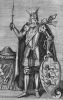
 941 - 1014 (73 years)
 [1, 3]

